If you own a small business and use a vehicle for work, you may have wondered:
“Do I really need commercial auto insurance, or will my personal auto policy cover me?”
This is one of the most important questions a business owner can ask before an accident happens.
The answer isn’t always as simple as “yes” or “no.” It depends on who owns the vehicle, how the vehicle is used, who drives it, and what the business is doing with it.
As an independent insurance broker with Insurance Ruff LLC, I regularly help business owners evaluate these situations. One of the biggest mistakes I see is business owners assuming that because a vehicle is personally owned, their personal auto insurance automatically covers everything they do with it for their business.
That assumption can create a significant coverage problem.
When Does a Business Need Commercial Auto Insurance?
A commercial auto policy may be appropriate when a vehicle is being used primarily in connection with a business.
Some common examples include:
- Contractors driving trucks or vans to job sites
- Electricians, plumbers, HVAC companies and handymen
- Landscapers and lawn-care companies
- Businesses delivering products to customers
- Companies transporting tools, equipment or materials
- Businesses with employees driving company vehicles
- Businesses that own vehicles in the company’s name
- Vehicles used to visit multiple customers or job sites every day
- Vehicles used to transport property belonging to customers
- Businesses with multiple vehicles or multiple drivers
The key isn’t simply whether you occasionally drive your vehicle for work.
The important question is what role the vehicle plays in your business.
“But It’s My Personal Truck”
This is one of the most common things I hear from small-business owners.
A contractor might say:
“The truck is in my name, I have a personal auto policy, and I just use it to get to my jobs.”
That doesn’t automatically mean the personal policy is the right solution.
There is a major difference between commuting to your job as an employee and using your vehicle as part of operating your own business.
For example, consider a contractor who:
- Drives his truck to several job sites every week
- Carries ladders, tools and expensive equipment
- Picks up building materials
- Visits customers
- Uses the truck to perform his business
That is very different from someone who simply drives their personal vehicle to an office every morning.
The more the vehicle becomes an essential part of the business operation, the more important it becomes to have the insurance program structured correctly.
A Real-World Example
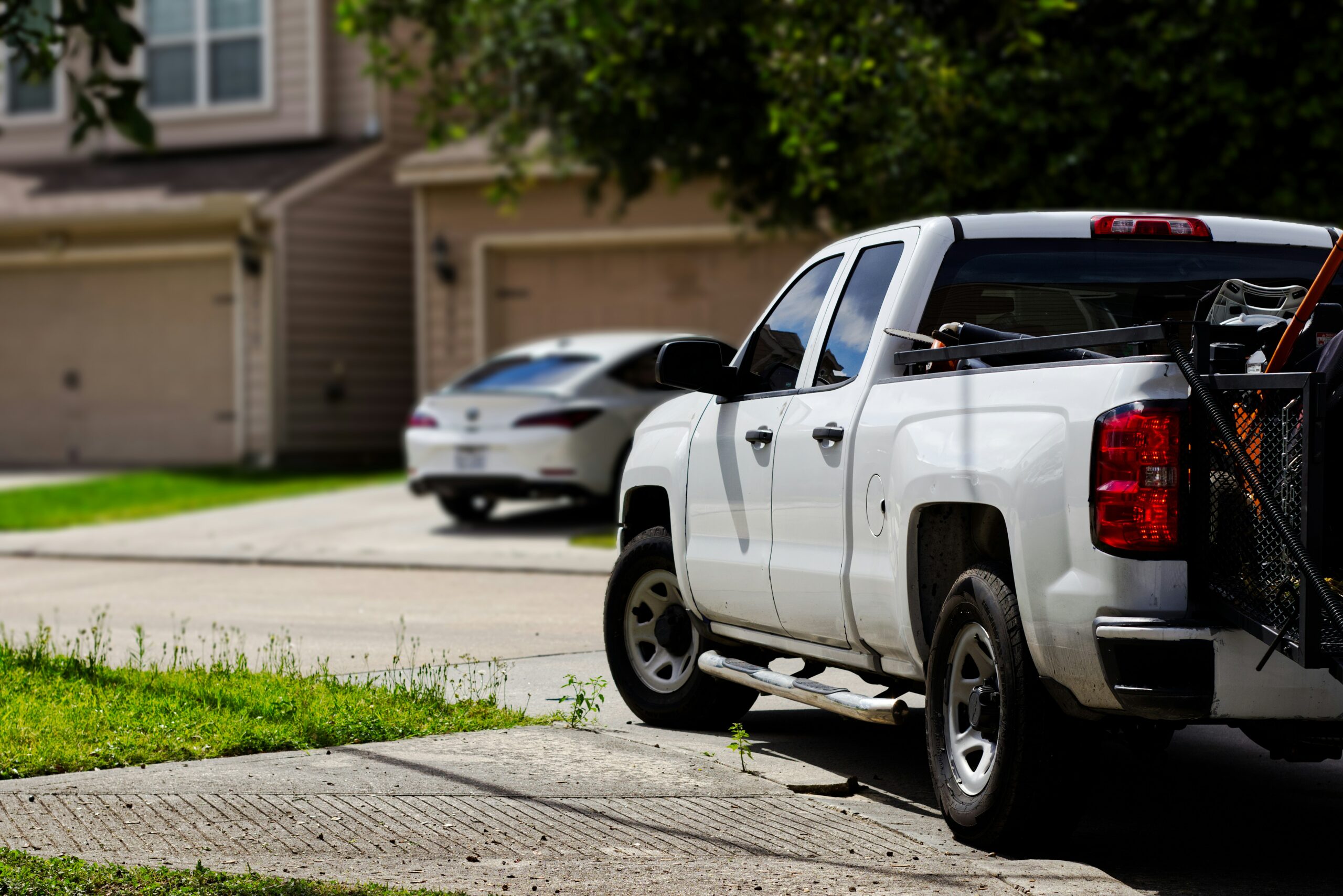
Imagine a small construction company owner who personally owns a pickup truck.
He uses it every day to drive to customers’ homes, transport tools, pick up materials and travel between job sites.
He assumes his personal auto policy is sufficient because the truck is titled in his personal name.
Then he gets into a serious accident while traveling between job sites.
The question isn’t just:
“Was the truck insured?”
The much more important question is:
“Was it insured correctly for how it was actually being used?”
Insurance companies look at the actual circumstances surrounding the vehicle and its use. That’s why I recommend that business owners discuss their actual operations with an insurance professional rather than simply assuming their current policy is adequate.
What About Driving to Job Sites?
This is where things can get confusing.
There is a difference between:
Driving to your regular workplace
and
Operating a business where your vehicle is used to travel to customers, job sites or locations where you perform work.
A contractor who drives from his home to one office every morning has a different exposure from a contractor who drives to five different customers’ homes every day while carrying tools and equipment.
Don’t assume that because you’re “just driving to a job” your personal policy automatically provides the coverage you need.
Tell your insurance agent exactly what you do.
What If Employees Use Their Own Vehicles?
This is another area small businesses frequently overlook.
Suppose you own a plumbing company and your employee uses their personal pickup truck to drive to a customer.
The employee’s personal auto insurance may provide coverage for the employee’s personal automobile exposure, but the business can have its own liability exposure arising from the employee’s use of that vehicle.
This is where Hired and Non-Owned Auto Liability, commonly called HNOA, can become important.
Hired auto generally refers to vehicles the business rents or borrows.
Non-owned auto generally refers to vehicles the business doesn’t own but that are used in connection with the business, such as an employee using their personal vehicle for business purposes.
HNOA coverage can be an important part of a small-business insurance program, but it isn’t a replacement for properly insuring a company-owned vehicle.
What If I Only Have One Business Vehicle?
You don’t necessarily need a large fleet to need commercial auto insurance.
A business with one pickup truck or one van can have just as much need to properly insure that vehicle as a company with 20 vehicles.
For example, a one-person electrical contractor may have:
- One pickup
- One employee
- Thousands of dollars of tools
- Regular customer visits
- Multiple job sites
- Significant liability exposure
The number of vehicles isn’t what determines whether commercial insurance is appropriate.
How the vehicle is used matters.
What If My Business Owns the Vehicle?
If the vehicle is titled to an LLC, corporation or other business entity, that is an important factor to discuss with your insurance agent.
Generally, you want the insurance policy and ownership structure to make sense together.
For example, if ABC Contracting LLC owns a pickup truck but the insurance is written in an individual’s name without properly addressing the business’s interest in the vehicle, there could be unnecessary complications following a claim.
This is one reason I don’t recommend simply buying the cheapest commercial auto quote without having someone review how the business is actually structured.
Commercial Auto Isn’t Just About the Vehicle
Another mistake I see is focusing entirely on the vehicle and ignoring the rest of the exposure.
When reviewing commercial auto insurance, I also want to understand:
- Who drives the vehicles?
- How many drivers are there?
- Are employees driving?
- What are the drivers’ histories?
- Where are the vehicles being driven?
- How far do they travel?
- Are tools or materials transported?
- Are customers’ property or products being transported?
- Are vehicles used for deliveries?
- Are trailers involved?
- Are vehicles leased or financed?
- Does the business rent vehicles?
- Do employees use personal vehicles for business?
These details can make a significant difference in determining what insurance program makes sense.
How Much Commercial Auto Liability Insurance Should a Business Carry?
There isn’t one liability limit that is right for every business.
A business owner should consider the potential severity of an accident, the type of business, the vehicles involved, the driving radius, the number of vehicles and drivers, contracts with customers, and the business’s overall assets and liability exposure.
For many small businesses, I recommend considering higher liability limits than the minimum required by law, particularly when the vehicle is an important part of the business.
A serious commercial auto accident can involve injuries, multiple vehicles and substantial property damage.
Saving a little money on premium by choosing inadequate limits may not be worth the financial risk.
Don’t Forget Physical Damage Coverage
Commercial auto isn’t only about liability.
If the business owns a vehicle, you may also need coverage for physical damage to the vehicle.
That can include:
Collision coverage — generally addresses damage resulting from a collision.
Comprehensive coverage — generally addresses covered losses such as theft, vandalism, fire, hail and other specified causes of loss.
For a business owner who relies on a truck or van every day to generate income, protecting the vehicle itself can be extremely important.
Imagine a contractor’s only work truck being stolen or totaled.
The issue isn’t simply the cost of replacing the vehicle.
The business may have difficulty operating without it.
What About Tools and Equipment in My Truck?
This is an important distinction.
Commercial auto coverage isn’t automatically the same thing as coverage for all of the tools and equipment you’re carrying.
A contractor might have $20,000 or $30,000 worth of tools in a truck.
The business owner should not assume that the auto policy automatically provides broad coverage for everything inside the vehicle.
Depending on the circumstances, other commercial insurance coverage may be needed to properly address business property, tools and equipment.
This is a great example of why I prefer to look at the entire business insurance picture, rather than quoting a vehicle in isolation.
What About Personal Vehicles Used for Business?
This is where the answer can become more complicated.
There are situations where a personal vehicle can be used for some business purposes without automatically meaning the owner needs a traditional commercial auto policy.
But the details matter.
An occasional business trip is different from using a vehicle as a primary tool of the business.
A real estate agent occasionally driving to a showing is different from a contractor transporting tools and materials between job sites every day.
A business owner should be completely transparent with their insurance agent about how the vehicle is being used.
Never assume. Ask.
The Biggest Mistake: Buying the Cheapest Policy
As an independent insurance agency, one of the advantages we provide at Insurance Ruff LLC is that we’re not limited to simply presenting one company’s solution.
We can shop multiple insurance companies and compare the coverage and pricing based on the business’s actual situation.
That matters because the cheapest quote isn’t necessarily the best insurance policy.
Two commercial auto quotes can have different:
- Liability limits
- Deductibles
- Vehicle coverage
- Driver requirements
- Usage classifications
- Coverage restrictions
- Endorsements
- Additional coverage options
- Underwriting requirements
A lower premium isn’t necessarily a better deal if the policy doesn’t properly address the business’s exposure.
Why Work With Insurance Ruff LLC?
At Insurance Ruff LLC, our goal isn’t simply to sell you another insurance policy.
We want to understand how your business actually operates and then help you determine what insurance makes sense.
As an independent Arizona insurance agency, we can shop multiple carriers rather than being tied to one insurance company.
That allows us to look at the bigger picture:
Your business → your vehicles → your drivers → how the vehicles are used → your liability exposure → your overall insurance program.
We can help business owners evaluate commercial auto insurance, HNOA coverage and other commercial insurance needs and then compare available options.
And because we’re an independent agency, if your business changes, we can shop the market again rather than assuming your current carrier will always be the best fit.
So, Do You Need Commercial Auto Insurance?
Maybe. But don’t guess.
If your vehicle is being used to operate your business, transport tools or materials, visit customers or job sites, make deliveries, or is owned by your business, it’s worth having an insurance professional review the situation.
Even if you ultimately don’t need a traditional commercial auto policy, getting the question answered correctly can give you confidence that your coverage matches what you actually do.
The worst time to discover a coverage problem is after an accident.
Let Insurance Ruff LLC Review Your Business Auto Insurance
If you’re a small-business owner in Arizona and you’re not sure whether your current auto insurance properly covers your business use, Insurance Ruff LLC can help.
We’ll look at how you actually use your vehicles, discuss the potential exposures and shop insurance options from multiple carriers to help you find the right combination of coverage and price.
Don’t wait until there’s a claim to find out whether your vehicle was insured correctly.
Visit Insurance Ruff LLC to request an insurance review or get started with a commercial auto quote.
Insurance coverage is subject to the terms, conditions, exclusions and limitations of the applicable policy. This article is for general educational purposes and is not a substitute for reviewing your specific insurance policy with a licensed insurance professional.